"Certified" and "notarized" get used interchangeably, but they are not the same thing—and picking the wrong one can delay an immigration case, a court filing, or a university admission by weeks. This guide breaks down what each actually means, who requires which, and how to order the right service the first time.
What is a certified translation?
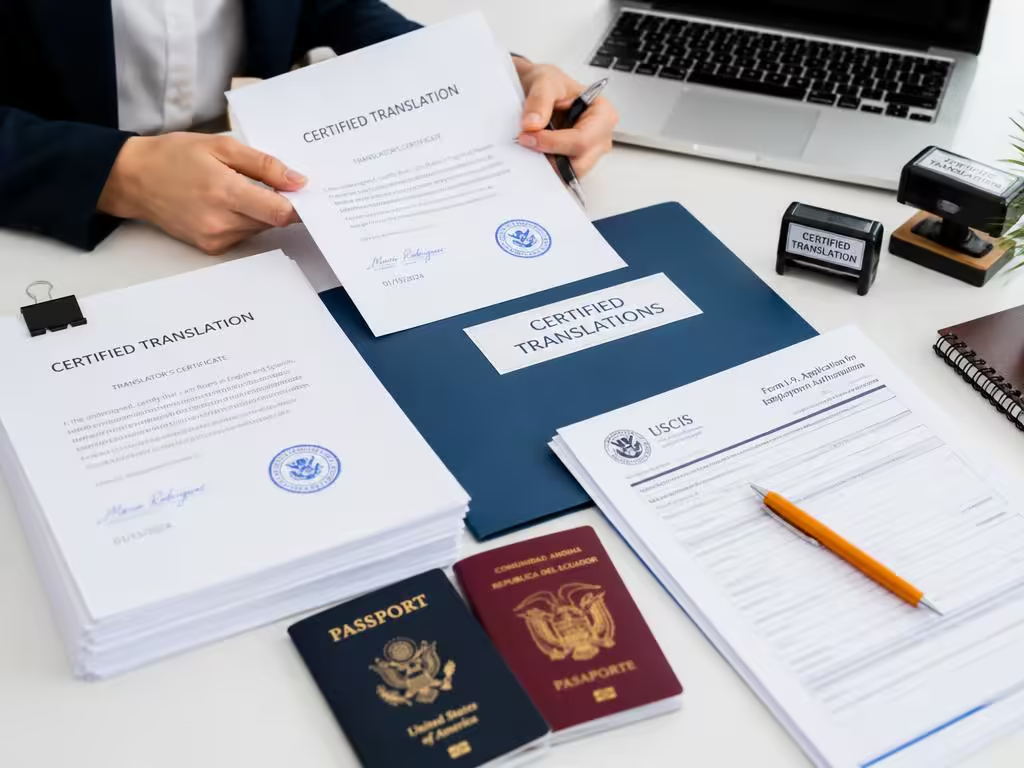
A certified translation is a word-for-word translation of the original document, delivered with a signed Certificate of Accuracy stating that the translator (or translation company) is competent in both languages and that the translation is complete and accurate. The certificate is signed and dated by the translator or an authorized representative of the language service provider. It is the standard required by USCIS, most U.S. courts, and the vast majority of universities.
- Contains a signed Certificate of Accuracy from the translator or agency.
- Includes the translator's name, signature, and date.
- Certifies the translation is complete and accurate — not the translator's identity.
- Required by USCIS for every foreign-language document in an immigration filing.
What is a notarized translation?
A notarized translation is a certified translation whose Certificate of Accuracy has additionally been signed in front of a notary public. The notary is not vouching for the quality of the translation—only verifying the identity of the person who signed the certificate. Notarization adds an extra layer of formality that some foreign consulates, state agencies, and older institutional processes still require, but USCIS explicitly does not.
“USCIS requires a certified English translation for every foreign-language document. Notarization is not required.”
— U.S. Citizenship and Immigration Services
USCIS, courts, and universities: who requires what
- USCIS (green cards, naturalization, asylum, visas): certified translation only. Notarization is not required and does not speed adjudication.
- U.S. state and federal courts: certified translation. A handful of clerks still ask for notarization on affidavits—check the local rule before filing.
- Universities and credential evaluators (WES, ECE): certified translation. A few programs still request notarized copies of diplomas.
- Foreign consulates, apostille processes, and some DMV or Social Security offices: often require notarization on top of certification.
How the two services differ in practice
In terms of the translation itself, there is no difference: the linguistic work, the formatting, and the Certificate of Accuracy are identical. The difference is a single additional step—an appointment with a notary, a notary stamp on the certificate, and a small notarization fee. For most Bylyngo clients ordering certified translation for USCIS, notarization adds cost and time without adding acceptance value.
How to pick the right one
- Start with the request letter or instructions from the receiving agency—it will say "certified translation" or "notarized translation" explicitly.
- If the destination is USCIS, choose certified. Do not add notarization.
- If the destination is a foreign consulate, apostille service, or specific state agency, confirm whether notarization is required in writing before ordering.
- When in doubt, ask your language service provider—Bylyngo can review the request letter and recommend the correct service.
Order the right service the first time
Bylyngo delivers both certified and notarized translations in 100+ languages, with rush turnaround available. Every certified translation includes a signed Certificate of Accuracy that meets USCIS, court, and university requirements. Upload your document and our team will confirm whether notarization is needed before we start.