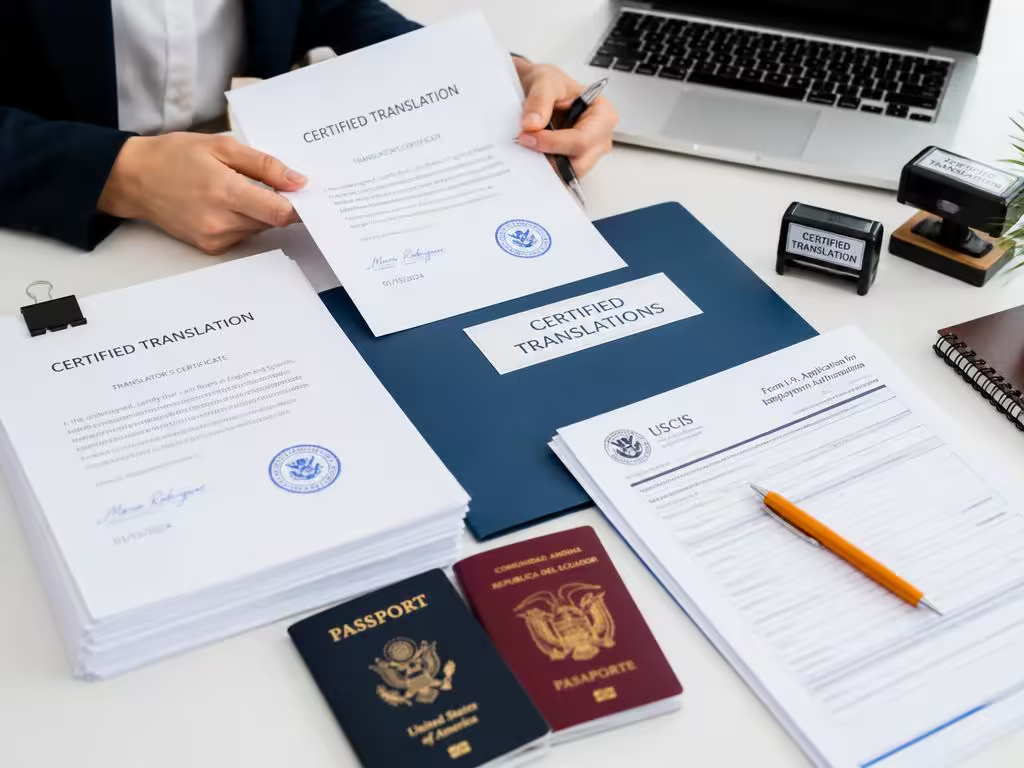
A certified translation is a professional translation of a document from one language into another, accompanied by a signed Certificate of Accuracy. The certificate states that the translator (or translation company) is competent in both languages and that the translation is a complete, accurate representation of the original. It is the standard USCIS, U.S. courts, and virtually every U.S. university require for any foreign-language document.
What must a certified translation include?
- A word-for-word translation of every visible element on the original document, including stamps, seals, and signatures (described in brackets).
- A signed Certificate of Accuracy identifying the translator or agency, attesting to competence in both languages, and confirming the translation is complete and accurate.
- The translator's or company representative's full name, signature, and the date of certification.
- Formatting that mirrors the original document so a reviewer can match fields side by side.
The role of the translator's statement
The Certificate of Accuracy — sometimes called the translator's statement — is what makes a translation "certified." It is a short, formal declaration on letterhead confirming that the person who translated the document is qualified and that the translation is accurate. It does not require a license, an oath, or a notary. USCIS specifically states that certification does not need to be notarized, and it does not need to come from a court-certified translator; it needs to come from someone competent in both languages who signs the statement.
“Any document in a foreign language must be accompanied by a full English translation which the translator has certified as complete and correct, and by the translator's certification that they are competent to translate from the foreign language into English.”
— 8 CFR § 103.2(b)(3) — USCIS translation requirement
When is notarization required — and when is it not?
Notarization only verifies the identity of the person who signed the Certificate of Accuracy — a notary is not evaluating translation quality. USCIS does not require notarization, and adding it does not speed up adjudication. Notarization is typically required only for foreign consulates, apostille processes, certain state agencies, and a small number of older institutional workflows. If the receiving agency does not ask for it in writing, a certified translation without notarization is sufficient.
Where certified translations are accepted
- USCIS — required for every foreign-language document in green card, naturalization, asylum, and visa filings.
- U.S. state and federal courts — required for exhibits, affidavits, and evidence in a foreign language.
- Universities and credential evaluators (WES, ECE, ICAP) — required for diplomas, transcripts, and academic records.
- Employers, licensing boards, and Social Security — required for foreign-language personal records used to establish identity, employment, or eligibility.
How to order a certified translation
Bylyngo delivers certified translations in 100+ languages with a signed Certificate of Accuracy that meets USCIS, court, and university requirements. Standard turnaround is 24–72 hours, with rush options available. Upload your document and our team will confirm the destination requirements before we start so you order the right service the first time.